MKR WAN 1310
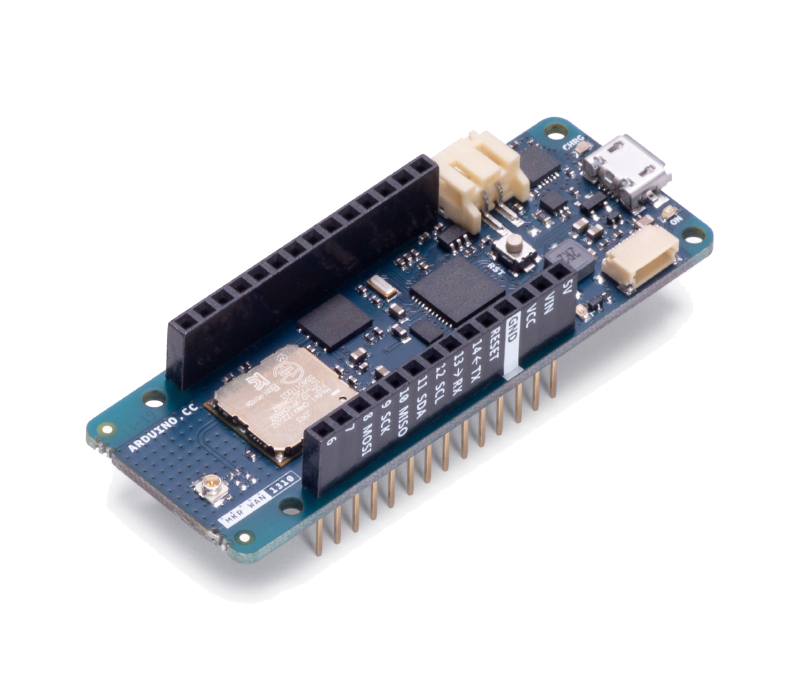
The Arduino MKR WAN 1310 is a development board that provides a practical and cost-effective solution to add LoRaWAN® connectivity for projects requiring long-range, low-power wireless communication. Sensors and actuators can be connected to the board through the analog, digital, UART, SPI, and I2C pins. The MKR WAN 1310 comes complete with an ATECC508 secure element, a battery charger, 2MByte SPI Flash, and power consumption as low as 104 uA.
About this device
The Arduino MKR WAN 1310 is a development board that provides a practical and cost-effective solution to add LoRaWAN® connectivity for projects requiring long-range, low-power wireless communication. Sensors and actuators can be connected to the board through the analog, digital, UART, SPI, and I2C pins. The MKR WAN 1310 comes complete with an ATECC508 secure element, a battery charger, 2MByte SPI Flash, and power consumption as low as 104 uA.
The MKR WAN 1310 supports 3 regional frequency plans and operates as a Class A LoRaWAN device. A payload codec is published in the repository, so uplinks are decoded automatically when you onboard it to The Things Stack.
Key features
- LoRa Alliance certified, verified interoperability with The Things Stack and other LoRaWAN network servers.
- Payload codec included, uplink decoder ready for one-click activation.
- 3 frequency plans supported: AU915-928, EU863-870, US902-928.
- Battery powered (Li-Ion / Li-Po, 1024 mAh minimum capacity, JST connector), user replaceable.
Vendor
At a glance
More from Arduino SA
Portenta Vision Shield LoRa®
Hardware specifications
| Model ID | mkr-wan-1310 |
| Dimensions | 67 × 25 × 0 mm |
| Weight | 32 g |
| Power | Battery — Li-Ion / Li-Po, 1024 mAh minimum capacity, JST connector, replaceable |
Sensors & capabilities
No sensors listed for this device.
Certifications & compliance
Standards
Network profiles
Capabilities are defined per firmware version and frequency plan, exactly as published in the repository.
Firmware 1.2.0
| Frequency plan | MAC | Reg. params | Class | Join | Max EIRP | Certified |
| EU863-870 | 1.0.2 | RP001-1.0.2 | A | OTAA | 16 dBm | ✓ Yes |
| US902-928 | 1.0.2 | RP001-1.0.2 | A | OTAA | 27 dBm | ✓ Yes |
Firmware 1.2.3
| Frequency plan | MAC | Reg. params | Class | Join | Max EIRP | Certified |
| AU915-928 | 1.0.2 | RP001-1.0.2 | A | OTAA | 27 dBm | — |
| EU863-870 | 1.0.2 | RP001-1.0.2 | A | OTAA | 16 dBm | ✓ Yes |
| US902-928 | 1.0.2 | RP001-1.0.2 | A | OTAA | 27 dBm | ✓ Yes |
Frequency plan coverage
Live decoder playground
Decode any hex payload client-side with the device's published codec, the exact code The Things Stack runs.
// pick an example or paste a payload, then Decode
Example uplink from The Things Stack
The full JSON message your application receives via MQTT or webhook when this device sends the payload above, raw bytes, decoded fields and radio metadata included.
// decode a payload above to see the full envelope
Codec source
// loading codec…
Add to The Things Stack
Manual setup
Create an application
In The Things Stack console, go to Applications → Create application and pick a unique application ID.
Register an end device
Choose From the LoRaWAN Device Repository and search for “MKR WAN 1310”. Select your firmware version and frequency plan.
Enter device credentials
Provide the DevEUI, JoinEUI and AppKey printed on the device label or QR code.
Power on & verify uplinks
Within a few minutes you'll see the join request and decoded uplinks in the Live data tab.