R816B - Wireless US Type Wall Socket with Power Meter
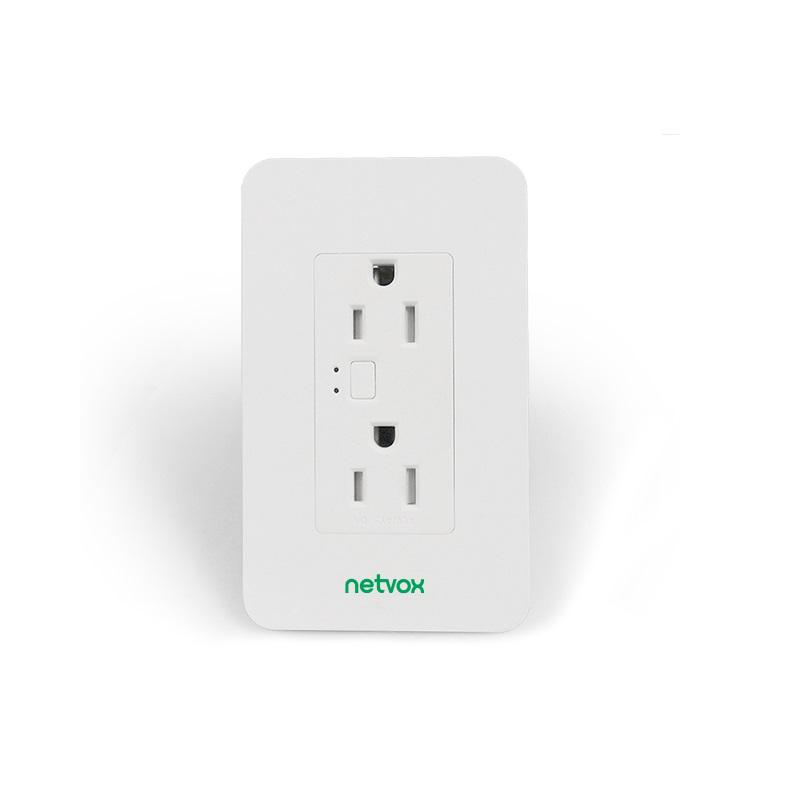
R816B (wireless wall socket with energy consumption monitoring (US)) is a smart electrical switch socket for indoor use. It is suitable for US standard wall cassette installation. The output socket is suitable for US standard 2 or 3 pole plug; rated output load is 15A/120V. R816B integrates LoRa/FSK modulation communication wireless module SX1276, which can realize wireless remote control. It can control the single-channel power output to be turned on and off through internal relay, and can detect the current, voltage, power, and electrical energy of the device connected to it. (The output of the upper socket is uncontrolled, the output of the lower socket is the relay control output, and the output power detection function is provided. There is a relay control button and two LED indicators between the two sockets.)
About this device
R816B (wireless wall socket with energy consumption monitoring (US)) is a smart electrical switch socket for indoor use. It is suitable for US standard wall cassette installation. The output socket is suitable for US standard 2 or 3 pole plug; rated output load is 15A/120V. R816B integrates LoRa/FSK modulation communication wireless module SX1276, which can realize wireless remote control. It can control the single-channel power output to be turned on and off through internal relay, and can detect the current, voltage, power, and electrical energy of the device connected to it. (The output of the upper socket is uncontrolled, the output of the lower socket is the relay control output, and the output power detection function is provided. There is a relay control button and two LED indicators between the two sockets.)
The R816B - Wireless US Type Wall Socket with Power Meter supports 7 regional frequency plans and operates as a Class A LoRaWAN device. A payload codec is published in the repository, so uplinks are decoded automatically when you onboard it to The Things Stack.
Key features
- Sensors: current, energy, voltage.
- Payload codec included, uplink decoder ready for one-click activation.
- 7 frequency plans supported: AS923, AU915-928, CN470-510, EU863-870, IN865-867, KR920-923, US902-928.
Vendor
At a glance
Hardware specifications
| Model ID | r816b |
| Dimensions | 113 × 69 × 39.5 mm |
| Operating temperature | -10 °C to 50 °C |
| Relative humidity | 0% to 0.85% |
Certifications & compliance
Standards
Network profiles
Capabilities are defined per firmware version and frequency plan, exactly as published in the repository.
Firmware 10
| Frequency plan | MAC | Reg. params | Class | Join | Max EIRP | Certified |
| AS923 | 1.0.2 | RP001-1.0.2-RevB | A | OTAA | 16 dBm | — |
| AU915-928 | 1.0.2 | RP001-1.0.2-RevB | A | OTAA | 20 dBm | — |
| CN470-510 | 1.0.2 | RP001-1.0.2-RevB | A | OTAA | 19 dBm | — |
| EU863-870 | 1.0.2 | RP001-1.0.2-RevB | A | OTAA | 16 dBm | — |
| IN865-867 | 1.0.2 | RP001-1.0.2-RevB | A | OTAA | 20 dBm | — |
| KR920-923 | 1.0.2 | RP001-1.0.2-RevB | A | OTAA | 14 dBm | — |
| US902-928 | 1.0.2 | RP001-1.0.2-RevB | A | OTAA | 20 dBm | — |
Frequency plan coverage
Live decoder playground
Decode any hex payload client-side with the device's published codec, the exact code The Things Stack runs.
// pick an example or paste a payload, then Decode
Example uplink from The Things Stack
The full JSON message your application receives via MQTT or webhook when this device sends the payload above, raw bytes, decoded fields and radio metadata included.
// decode a payload above to see the full envelope
Codec source
// loading codec…
Add to The Things Stack
Manual setup
Create an application
In The Things Stack console, go to Applications → Create application and pick a unique application ID.
Register an end device
Choose From the LoRaWAN Device Repository and search for “R816B - Wireless US Type Wall Socket with Power Meter”. Select your firmware version and frequency plan.
Enter device credentials
Provide the DevEUI, JoinEUI and AppKey printed on the device label or QR code.
Power on & verify uplinks
Within a few minutes you'll see the join request and decoded uplinks in the Live data tab.