TTN doesn’t support this in v2, the current deployment:
but the measurement of battery value is rather vital to many of our nodes so hopefully it will be incorporated in to v3 at some stage.
I’m not sure the detail on what was expected to put in to the battery level value was overly considered as it is rather generic - as you say, the chemistry and the devices usage will all massively vary so I suspect it’s up to the manufacturer of the device to decide based on what it is and what they recommend for power. And then we have a situation where until more network servers support this functionality, they won’t include it. And for some devices, you’d like a whole lot of other information too.
I generally deploy with Energizer Lithium batteries - they have a long shelf life, that is they self-discharge slower than the node uses them and are less temperature sensitive - so won’t freeze (not an issue in the UK, global warming is real).
I transmit battery V with each test device payload with a couple of decimal places and I’ve got several algorithms looking for the blip at the half way point and then the beginning of the end where the reported voltage is about to drop off a cliff. I’m trying to factor in some consideration of usage based on the message count.
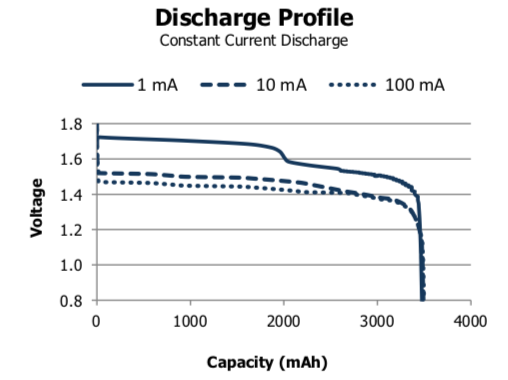
For deployed devices I schedule different payloads on different ports depending on use case / requirements. So generally device status once a day, for battery it’s a single byte scaled over the working range (1.8 to 1.4 in the example above) to give some level of over-accuracy.
It only takes a few minutes on the bench with a variable power supply & a multimeter to determine lowest operational voltage for purchased devices.
I’ve not yet had a mass deployment reach end of battery life but no one is talking to me about changing the batteries as the cost of many of the devices is sufficiently low they are adding new features and so the old device will be replaced with new one rather than have it’s batteries changed. In some instances this replacement may occur well before end of battery life.
For solar, test nodes have an INA3221 on them so we can measure the solar output, the flow in or out of the battery and the device usage. This gives more data than I can cope with so I haven’t come to any particularly conclusions except that 100mA LiPo battery on a simple device seems sufficient even in the UK and the deployed devices with that size battery work OK unless foliage get in the way.
So given time, as a small scale device maker, I could incorporate a 1-254 battery level based on rough lookup tables, but mostly I’d be inclined to know other things as well so would stick to the device status payload scheme, one of my favourites being the microswitch on the back of some cases that tells me if it’s been removed …