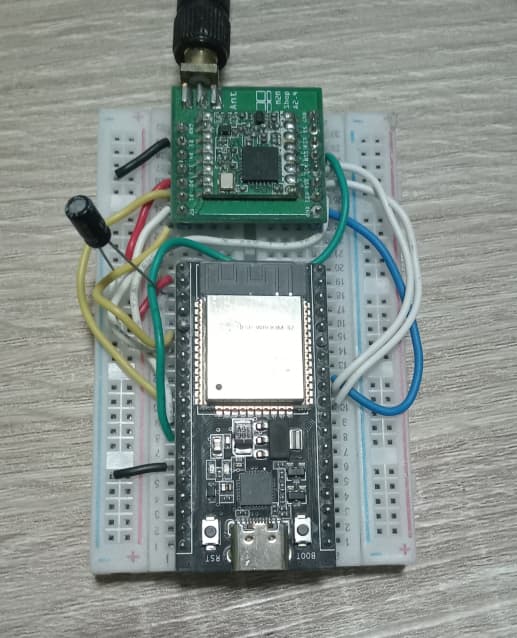
You’re definitely best off asking this in a GitHub issue on that repository, as the author will have much more experience than all of us combined given how new that is..
I’ve taken a quick look and the library tells you you have an SX1262 if a certain register doesn’t hold the expected value for SX1276. With that logic, a failed read will still say there is a 1262. The printed value 0x09 does look like it did read something but no clue if it read the right thing. Really, I’d ask the author instead.
Oh wow I see, that’s… something.
You can always find someone’s GitHub email address by opening a specific commit and adding .patch to the URL. No guarantee that they look at that inbox or want to respond then, but it’s still probably more helpful than asking here.
It may work in theory, but it’s only LoRaWAN v1.0.0 and using it on the Heltec v4 will bring you in trouble with the European RF police due to its +15dBm additional power output, and EU is the only region in the library. So I would heavily advise against using it at all, please
I think it uses LoRaWAN 1.0.x, and the default TX power is 17 dBm. This power level is allowed in my country.
To use a different frequency region, simply create a file such as AS923.py and add a list of frequencies. The full frequency list will be received from the LNS.
1.0.0 is 1.0.x?
I mention the Heltec v4 since it has an additional +15dBm Power Amplifier after the radio. So when the radio thinks it is transmitting at 16dBm the whole board is radiating 16+15dBm (although the PA goes back to +12 at that level for a total of 28dBm). Which hugely breaks the RF laws for Europe.
Your suggestion only works for dynamic bands, not for fixed bands such as US915 which work vastly different.
Really, I advise to not use this at all. The best option I’ve seen for MicroPython is the user in another topic here who compiled LoRaMac-Node into MicroPython with the proper C-bindings.
If there are parts that aren’t yet complete, why not encourage the community to help improve and perfect it—especially since the entire source code is provided—instead of advising against using it?
You may not know that I am the main author of the LoRaWAN implementation of RadioLib. I do not mention this to brag, but I may have a clue how insanely much effort it takes to ‘perfect’ a LoRaWAN driver (if that is even remotely possible). Spoiler: it is absolutely disgusting. I’ve likely spent 500+ hours by now myself, completely for free, and to this day get bug reports.
So while it is a possibility to do this, I would encourage you / the community to use readily available options instead.
I seem to recall that you gave a talk about RadioLib at the TTN Conference. Your work is truly excellent, and I am very grateful that you dedicated so much of your valuable time to developing it. I use it whenever I’m working in C, though when I use MicroPython, I have to look for an alternative.
I recently discovered that this MicroPython library is linked to https://molenet.org/, which originated as a student project at the University of Bremen in Germany. However, I’m not entirely sure who currently maintains it, as there are no comments in the code headers indicating its origins.